Public Money Watch
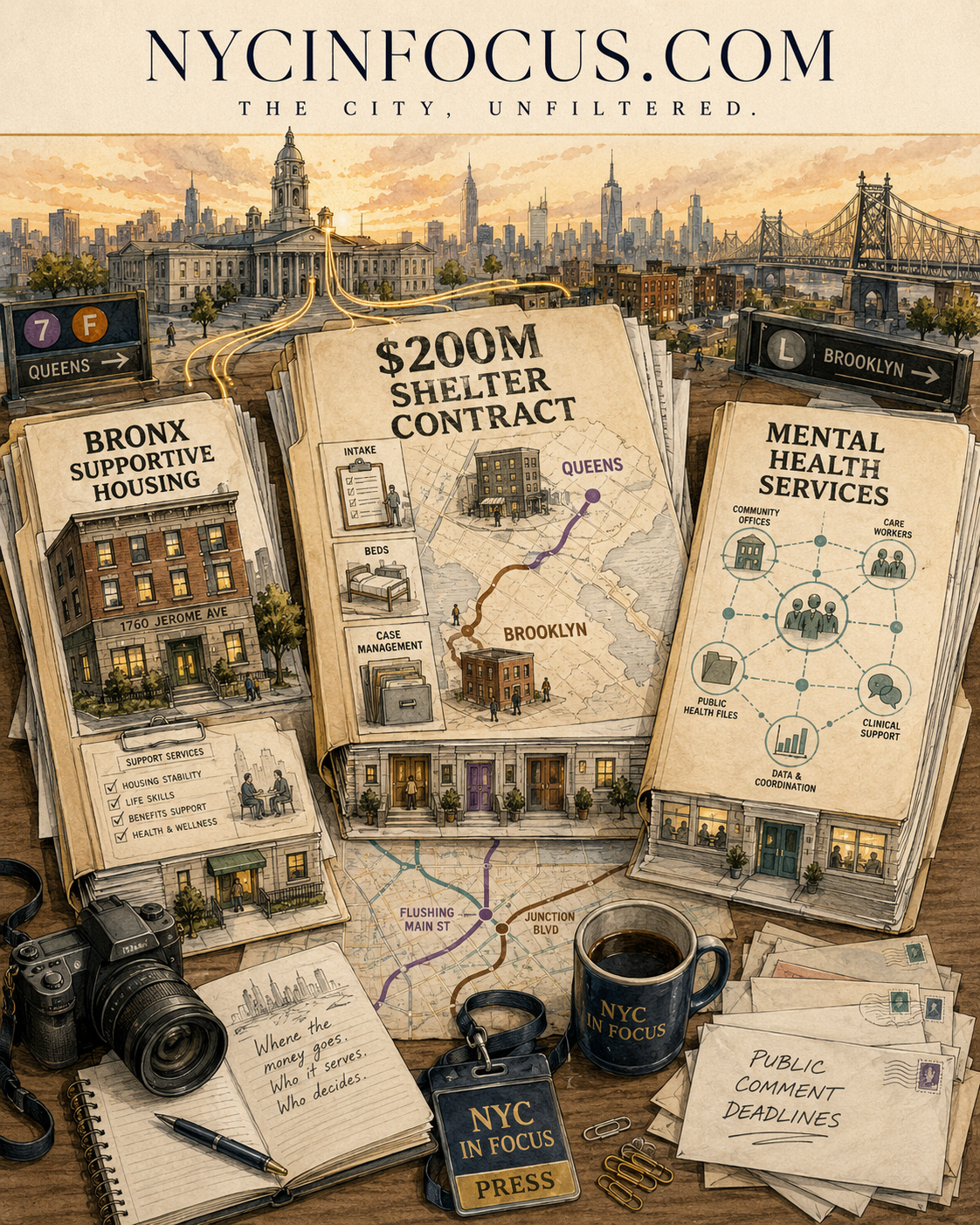
Official public notices reviewed by NYC In Focus show a proposed $200 million shelter contract for homeless single adults in Queens and Brooklyn, plus a Bronx supportive-housing contract and a $141 million mental-health services award.
New York City is seeking public comment on a proposed $200,036,708 shelter contract with Samaritan Daytop Village, Inc. for homeless single adults in Queens and Brooklyn.
That is the lead.
The proposed Department of Homeless Services contract covers shelter facilities for homeless single adults. The contractor address is listed as 138-02 Queens Boulevard in Briarwood, Queens. The contract term runs from July 1, 2026, through June 30, 2031, with a renewal period listed from July 1, 2031, through June 30, 2035.
Public comments are due by 10:00 a.m. on Thursday, June 11, 2026.
A $200 million shelter contract is not an abstract procurement item. It is city money moving through the homelessness system at a scale most New Yorkers never see until a facility opens, a neighborhood meeting gets tense, or a budget line quietly becomes a contract.
The $200M shelter contract
The proposed agreement lists Samaritan Daytop Village as the contractor for shelter facilities serving homeless single adults in Queens and Brooklyn.
The public notice does not list specific shelter addresses, the number of beds, staffing levels, service model details, or neighborhood-by-neighborhood placement information. It does list the maximum value: $200,036,708.
That number matters because shelter contracts are where policy becomes operations. A city can debate homelessness in speeches, hearings and budget charts. But the daily work happens inside contracts: beds, case management, security, food, maintenance, intake, placement work, transportation, staffing and building operations.
New Yorkers do not need to be procurement lawyers to understand the basic question: what does $200 million buy, where does it operate, and how will the city measure whether it works?
Why Queens and Brooklyn matter
The notice identifies the service area as Queens and Brooklyn. That is broad enough to cover millions of residents and dozens of neighborhoods.
Queens and Brooklyn already carry heavy parts of the city’s shelter, housing and immigrant-services infrastructure. They are also places where local concerns tend to arrive late in the process, after the paperwork has already done most of the talking.
The official record reviewed by NYC In Focus does not say where the shelter facilities will be located. It does not say whether this contract covers existing facilities, expanded capacity, replacement services or a mix of operations.
That gap is the story.
Bronx supportive housing: $34.45M for 105 single adults
The same set of public notices includes a proposed $34,453,125 Department of Health and Mental Hygiene contract with ACMH, Inc. for supportive housing.
The listed site is 1760 Jerome Avenue in the Bronx. The scope says the contractor would provide housing and support services for 105 single adults in a congregate supportive-housing setting.
The listed term runs from December 1, 2026, through November 30, 2041. Public comments are due by 2:00 p.m. on Friday, June 12, 2026.
Supportive housing is different from emergency shelter. It is designed for people who need housing with attached services. The word “supportive” is doing real work there: the housing is supposed to come with help, not just a key and a lease packet.
The public record identifies the site and the number of adults served. It does not explain the referral pipeline, staffing model, security plan, neighborhood engagement process or expected opening timeline.
Bronx residents deserve those details before the conversation gets reduced to slogans.
$141M for mental-health and developmental-disability services
Another major award listed in the records is a $141,171,708 Department of Health and Mental Hygiene contract with the Research Foundation for Mental Hygiene, Inc.
The notice says the contract is required to maintain program and personnel stability and provide community-based services. It says the Research Foundation for Mental Hygiene is responsible for support connected to the Division of Mental Hygiene and community-based services in New York City for people with intellectual and developmental disabilities.
The contractor address is listed in Menands, New York, near Albany.
This is not the same kind of contract as a shelter facility. It is a services-and-stability contract. Still, the dollar figure belongs in the same public-money conversation because the city’s homelessness, supportive-housing, mental-health and disability-service systems do not operate in separate worlds.
They meet in the lives of people who need housing, care, stability, benefits, case management and a city system that can do more than refer them from one office to another.
What the official record does not say
The $200 million shelter notice does not list specific facility addresses, expected bed counts, staffing ratios, performance benchmarks or neighborhood-level service locations.
The Bronx supportive-housing notice identifies the site and population count, but does not spell out the operating model, expected move-in timeline or community-notification process.
The $141 million mental-health services award explains the need for continuity and staffing support, but the public notice does not break down spending by program, borough or service category.
That does not mean the answers do not exist. It means they are not visible in this notice.
How the public can comment
For the proposed Samaritan Daytop Village shelter contract, comments must be submitted by 10:00 a.m. on Thursday, June 11, 2026. The notice instructs the public to submit comments to the Department of Social Services / Department of Homeless Services and include the listed E-PIN.
For the proposed ACMH supportive-housing contract, comments must be submitted by 2:00 p.m. on Friday, June 12, 2026. The notice instructs the public to submit comments to the Department of Health and Mental Hygiene and include the listed E-PIN.
Public-comment windows like these are short. They also tend to arrive in the language of procurement, which is a very efficient way to make regular people stop reading.
Do not stop reading.
Why it matters
The city’s shelter and supportive-housing systems are often covered only when something breaks: a neighborhood protest, a lawsuit, a building incident, a budget fight, a public-safety complaint or a family caught in the system with nowhere else to go.
The money moves earlier.
A proposed $200 million shelter contract, a $34.45 million Bronx supportive-housing contract and a $141 million mental-health services award show the machinery behind the headlines. These are the documents that decide who operates services, where the money goes, and how much public detail New Yorkers get before decisions harden into operations.
NYC In Focus will keep tracking the city’s shelter, housing, mental-health and public-service contracts as they move through public notices, hearings, awards and neighborhood impact.
Have a tip, correction, public meeting notice, event lead or document? Contact NYC In Focus.
Browse more civic coverage at Latest News, check upcoming public events on the NYC In Focus Events Calendar, or review the site’s Editorial Standards and Corrections Policy.