By Howard Weiss | May 27, 2026 | NYC In Focus · Accredited Press
NYC Department of Finance Commissioner Richard Lee received the final FY2027 property tax assessment roll on Tuesday, May 26 — the document that determines how much every property owner in New York City pays in real property tax for the fiscal year starting July 1.
Official NYC public procurement notices and agency filings reviewed by NYC In Focus show the assessment roll is now final, with bills due in accordance with NYC Charter Section 1519-a. Properties assessed at $250,000 or less are billed quarterly; properties above $250,000 are billed semi-annually. Unpaid taxes become a lien on the property.
The roll itself is public. So is the per-property data behind it. Property owners can look up their own assessment at propertyinformationportal.nyc.gov and review the citywide roll at nyc.gov/assessments.
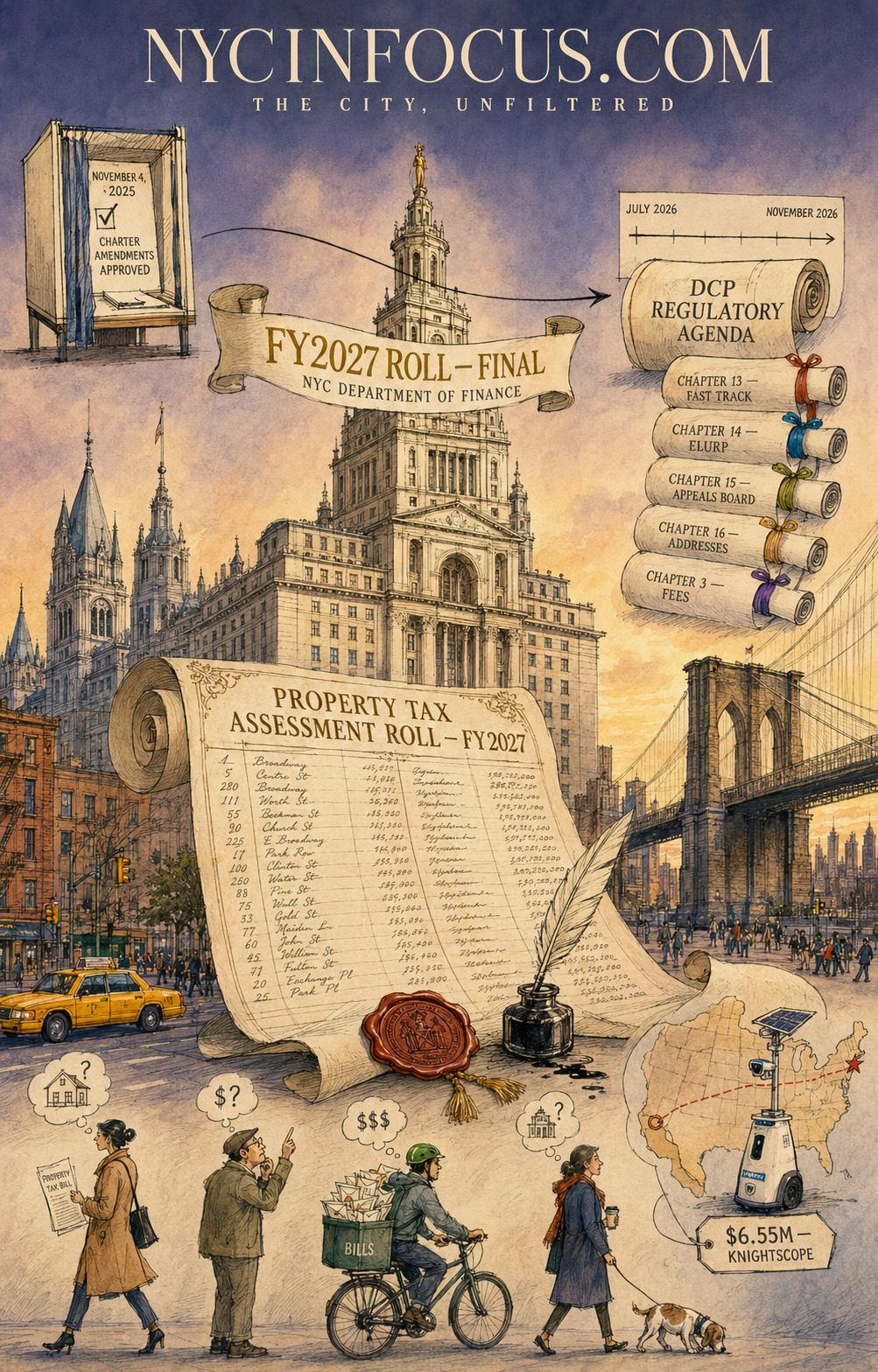
Also published today: the NYC Department of City Planning’s FY2027 Regulatory Agenda, which begins the formal rulemaking process to implement the New York City Charter amendments approved by voters on November 4, 2025 — the Affordable Housing Fast Track, the Expedited Land Use Review Procedure (ELURP), the Affordable Housing Appeals Board, and a new street address assignment authority for the Director of City Planning.
Translation: the procedural rules for how NYC processes affordable housing land use applications going forward are about to be written, and the rulemaking calendar starts now.
What’s Happening
Two major NYC policy actions hit the public record today on the same day.
First, the FY2027 property tax assessment roll has been finalized. The roll covers the fiscal year running July 1, 2026 through June 30, 2027 and assigns an assessed value to every property in the five boroughs. That assessed value, combined with the tax class rate, determines the property tax bill.
Second, the Department of City Planning published its FY2027 Regulatory Agenda — the official notice that DCP, in conjunction with the City Planning Commission, will begin promulgating five new chapters of rules to implement the City Charter changes that NYC voters approved at the November 2025 ballot.
The rulemaking covers:
- Chapter 13 — Affordable Housing Fast Track methodology: the formula that determines which 12 community districts had the lowest rate of affordable housing development over the prior five years, triggering fast-track processing.
- Chapter 14 — Expedited Land Use Review Procedure (ELURP): the new shortened review track for qualifying land use applications under Charter Section 197-e.
- Chapter 15 — Affordable Housing Appeals Board: the new appeals body that can override Borough President and Community Board land use denials in qualifying cases.
- Chapter 16 — Address Assignment: the new authority of the Director of City Planning to assign street numbers to buildings, plus enforcement and civil penalties.
- Chapter 3 — Fees and Contributions: amendments to extend existing ULURP application fees to applications processed under the new ELURP track.
All five rulemakings are scheduled to be promulgated between July and November 2026. That is a fast turnaround.
The FY2027 Property Tax Roll
The property tax assessment roll is the foundational document of NYC municipal finance. Every owner of real property in the five boroughs is on it. Every property tax bill — and every NYC tax lien sale — flows from it.
Department of Finance Commissioner Richard Lee received the final roll on Tuesday, May 26. From there, the standard NYC property tax billing cycle kicks in under NYC Charter Section 1519-a.
Quarterly billing applies to properties assessed at $250,000 or less. These are mostly one- to three-family homes in the outer boroughs and smaller residential properties.
Semi-annual billing applies to properties assessed above $250,000. This includes most commercial properties and larger residential buildings.
Discounts may be available for early payment. Unpaid property taxes eventually become liens on the property — and NYC’s lien sale is one of the most consequential events that can happen to a NYC property owner who falls behind.
The roll is public. Property owners can look up their own assessment at propertyinformationportal.nyc.gov. The citywide assessment roll and tax class rate information is at nyc.gov/assessments. Property owners with questions about their assessment have a narrow window to file a Tax Commission challenge before bills come due.
The City Planning Regulatory Agenda
On November 4, 2025, New York City voters approved a series of City Charter amendments that fundamentally restructure how NYC processes certain land use applications — particularly applications involving affordable housing.
The amendments created three new mechanisms under the Charter:
Section 197-e (ELURP): An Expedited Land Use Review Procedure that compresses the standard ULURP timeline for qualifying applications. This is the most consequential procedural change to NYC land use since ULURP itself was adopted in 1975.
Section 197-f (Affordable Housing Fast Track): A mechanism that identifies the 12 community districts with the lowest rate of affordable housing development over the prior five-year period, and applies a fast-track review process to qualifying affordable housing projects in those districts.
Section 197-g (Affordable Housing Appeals Board): A new appeals body with authority to review and potentially override Borough President or Community Board denials of affordable housing applications meeting the eligibility criteria.
The Department of City Planning, working with the City Planning Commission, is now writing the implementing rules for all three. The published agenda sets a target schedule of July through November 2026 — meaning the rules will be in place before the end of calendar year 2026.
Public input on the rules will happen through the standard CAPA (City Administrative Procedure Act) process under NYC Charter Section 1043 — meaning a public hearing and a public comment period before final adoption. Anyone who works on, lives near, or cares about NYC housing development should be watching this rulemaking closely.
Address Assignment: A Quietly Major Change
One additional Charter amendment from the November 2025 ballot received less attention than the housing-focused changes but is going through the same rulemaking pipeline today.
The amended NYC Charter Section 198 now requires the Director of the Department of City Planning to assign street numbers to buildings — a power historically scattered across multiple agencies. The new DCP rule (Chapter 16) will cover three things:
- The display, size, form, visibility, and location of street numbers on buildings.
- Enforcement of street number requirements.
- Civil penalties for non-compliance.
The likely individuals and entities subject to the rule, per the published agenda: applicants for tax lot reapportionments and applicants for building permits for new construction or for construction that changes the occupancy of or access to existing buildings.
It is the kind of administrative reform that does not make headlines but absolutely shapes the daily logistics of NYC — emergency response, package delivery, voter registration, all of it depends on accurate street addresses.
Public Hearing Schedule
The rulemaking process for the City Charter amendments will include formal CAPA hearings as each rule is proposed. Those hearing dates have not yet been published. But several major land use and housing hearings are already on the calendar for the next two weeks.
NYC City Council Subcommittee on Zoning and Franchises
Wednesday, May 27, 2026
11:00 AM
250 Broadway, 8th Floor, Committee Room 3
DeWitt Clinton Park North dual rezonings + Monitor Point Greenpoint rezoning
Livestream: council.nyc.gov/live
Charter Revision Commission Public Hearing
Wednesday, May 27, 2026
7:00 PM
Albert Einstein College of Medicine, 1300 Morris Park Avenue, Bronx
Brooklyn Borough Board — Lefferts Historic House + Coney West Parcel A
Tuesday, June 2, 2026
6:00 PM
Brooklyn Borough Hall, 209 Joralemon Street
Written testimony deadline: Friday, June 5
NYC Rent Guidelines Board — Public Hearing (Queens)
Thursday, June 4, 2026
5:00 PM – 8:00 PM
Jamaica Performing Arts Center, 153-10 Jamaica Avenue
NYC Rent Guidelines Board — Public Hearing (Bronx)
Monday, June 8, 2026
5:00 PM – 8:00 PM
Hostos Community College, 450 Grand Concourse
NYC City Planning Commission
Wednesday, June 3, 2026
10:00 AM
120 Broadway, Lower Concourse, Hearing Room
LPC Public Hearing
Tuesday, June 9, 2026
9:00 AM
253 Broadway, Manhattan
Includes the Frank Lloyd Wright Usonian house at 48 Manor Court (continued)
How New Yorkers Can Participate
On the property tax roll: NYC property owners who disagree with their FY2027 assessment can file a challenge with the NYC Tax Commission. Forms and deadlines are at nyc.gov/taxcommission. Property owners can also review their assessment at propertyinformationportal.nyc.gov.
On the City Planning rules: Each of the five new rulemakings will be subject to CAPA public hearings under NYC Charter Section 1043. Notice of those hearings will be published in advance through official city government channels. Anyone can submit written comments through nyc.gov/dcp during the public comment period for each rule.
On the rent guidelines: Pre-registration to testify at the four public hearings on the proposed 2026–27 rent adjustments is recommended. Register online at nyc.gov/rgb or call 212-669-7480. Written testimony to be considered before the final June 25 vote must be received by Tuesday, June 16.
On the City Council rezonings: Testimony at today’s Subcommittee on Zoning and Franchises hearing can be given in person at 250 Broadway or remotely. Information on how to testify is at council.nyc.gov/land-use.
What the Official Record Says
Official NYC public records describe the FY2027 property tax assessment roll as “final” — meaning the Department of Finance can now begin generating individual property tax bills under the standard cycle. Real property taxes are due and payable in accordance with the timeframes set forth in NYC Charter Section 1519-a.
On the Charter implementation rulemaking, the published Regulatory Agenda is the official notice required by NYC Charter Section 1042 — DCP’s commitment that the rules will be promulgated during FY2027.
On November 4, 2025, New York City voters approved amendments to the City Charter that alter the City’s land use process, including establishing a new Affordable Housing Fast Track contained in the new Section 197-f of the Charter. This rule, by and with the City Planning Commission, is necessary to implement the Affordable Housing Fast Track and required by section 197-f(a) of the Charter.
The legal basis for each of the five rule chapters is identified in the agenda. The Affordable Housing Fast Track, ELURP, and Appeals Board rules are all rooted in Sections 197-e, 197-f, and 197-g of the Charter, respectively, with general rulemaking authority under Section 1043.
What the Official Record Does Not Say
The FY2027 property tax assessment roll, as published today, does not include individual property-level assessment data in the official public notices themselves. That data lives on the Department of Finance’s Property Information Portal, where each property owner can look up their own assessment, tax class, and projected bill. Aggregate roll statistics — total citywide assessed value, average changes by borough — typically follow in a separate Department of Finance press release.
The City Planning regulatory agenda does not include the actual text of any of the five new rule chapters. Those will be published separately as each rule is proposed, with their own CAPA notices. Today’s filing is the procedural commitment that the rules are coming.
The agenda also does not specify how the Director of City Planning will identify the 12 community districts subject to the Affordable Housing Fast Track. The methodology will be published as part of the Chapter 13 rulemaking — with a target schedule of February through May 2026, which has already passed without the rule being finalized. The current published agenda confirms the rulemaking has slipped behind its original timeline.
None of the five new Chapter rules has yet been published in proposed form for public comment.
Official Source Links
NYC In Focus reviewed the following official NYC public records and primary sources for this story:
- NYC Department of Finance — Property Tax Assessment Roll
- NYC Property Information Portal
- NYC Department of Finance — Property Tax
- NYC Tax Commission — Assessment Appeals
- NYC Department of City Planning
- NYC City Council — Land Use Committee Materials
- NYC Rent Guidelines Board
- NYC Charter Revision Commission
Also Buried in Today’s Public Records
The property tax roll and the City Planning agenda were not the only significant items in today’s public filings.
NYC awards $6.55 million to a California robotics company for emergency call box maintenance.
NYC Police Department is seeking public comment on a sole-source contract worth $6,555,434.69 to Knightscope Inc., based in Sunnyvale, California, for Solar Emergency Call Box maintenance and repair citywide. Term runs five years with three optional three-year renewals — meaning the contract could extend to February 2040 at a total value well above the current ceiling. Comments due 2:00 PM Wednesday, June 3.
$163 million East Side Greenway 14th Street design-build contract goes to Skanska.
NYC Department of Design and Construction awarded a $163,109,320 design-build contract for the East Side Greenway 14th Street Connector to Skanska USA Building Inc. of 350 Fifth Avenue, Manhattan. A separate $400,000 component goes to Walsh Construction Company II, LLC of Little Falls, NJ. Public comment period ends 4:00 PM June 3.
Seven more nine-year home care contracts published — mostly Brooklyn-based providers.
NYC HRA awarded seven more home care services contracts with $1.00 placeholder amounts to providers serving Medicaid-eligible elderly and disabled New Yorkers. New awards went to White Glove Community Care (Brooklyn), Heart to Heart Home Care (Brooklyn), All Heart Homecare Agency (Brooklyn), Selfhelp Community Services (Manhattan), Cooperative Home Care Associates (Bronx), Pomonok Home Services (Fresh Meadows, Queens), and Community Care Companions Inc. (Smithtown, Long Island — outside the five boroughs). All nine-year terms. Combined with Tuesday’s six awards, that’s now 13 home care providers under nine-year placeholder contracts to serve some of NYC’s most vulnerable residents.
$3.36 million Brooklyn tree-damaged sidewalk reconstruction renewal.
NYC Parks awarded a renewal to William A Gross Construction Associates of New Hyde Park, Nassau County, for $3,355,838 to reconstruct tree-damaged sidewalks across Brooklyn Community Boards 3-5, 8-9, and 15-18.
NYC Sanitation seeks comment on six BID containerization contracts.
NYC DSNY is seeking public comment on six BID-administered containerization program contracts totaling $1,340,812: 34th Street Partnership ($558,750), Bryant Park Corporation ($135,375), Hudson Square District Management Association ($168,750), Sutphin Boulevard District Management Association ($225,000), Center for Employment Opportunities ($109,676), and Neighborhood Initiatives Development Corporation ($143,261). Comments due 11:59 PM Wednesday, June 3.
NYC Health Code amendments on pregnancy loss reporting.
The NYC Board of Health adopted final amendments to Article 203 of the NYC Health Code aligning local reporting requirements with the 2025 amendments to New York State Public Health Law Section 4160. The amendments narrow induced termination reporting to only instances where a disposition is requested by the parent, and rename “fetal death” to “pregnancy loss.” Adopted at the Board of Health’s May 19 meeting.
Texas-based smartphone safety app contract renewed for ACS field workers.
NYC Administration for Children’s Services renewed a $417,819 contract with Alert Media Inc. of Austin, Texas for the SafeSignal Smartphone Safety App used by field workers — a panic-button alarm system that connects ACS staff to monitoring services with GPS location.
Different agencies, different rules, same civic lesson: the paperwork is public, but it rarely comes looking for you.
What This Actually Means
For NYC property owners, the FY2027 assessment roll is the number that matters. If your assessment changed from last year — particularly upward — you have a window to challenge it with the Tax Commission before bills come due. Look up your property at propertyinformationportal.nyc.gov today.
For NYC renters and housing advocates, today’s City Planning regulatory agenda is the signal that the implementation of the November 2025 ballot measures is officially underway. The Affordable Housing Fast Track, ELURP, and Appeals Board rules will be drafted, hearing-noticed, and adopted between July and November 2026. Anyone who works on or cares about NYC housing policy should be tracking each of those rulemakings as they come up.
For the rest of the city, today’s records reveal an interesting pattern: a $6.55 million sole-source NYPD robotics contract going to California for emergency call box maintenance. A $163 million East Side Greenway design-build. Seven more home care providers receiving nine-year placeholder contracts on top of the six awarded yesterday. The procurement keeps moving.
In a city where land use rules decide what gets built and property tax bills decide what gets paid, the documents that shape both arrived on the same day. That is worth a closer look.
Source note: This story is based on official NYC public procurement notices, agency filings, NYC Department of Finance assessment roll records, NYC Department of City Planning Regulatory Agenda, NYC City Council and City Planning Commission hearing materials, and supporting government records reviewed by NYC In Focus. Official source links are included above. Photo by Howard Weiss for NYC In Focus.