HOUSING · CITY HALL · BROOKLYN
Intro 905-A gives HPD-certified nonprofits the first chance to buy certain distressed and income-restricted apartment buildings before they hit the open market. It takes effect in one year.

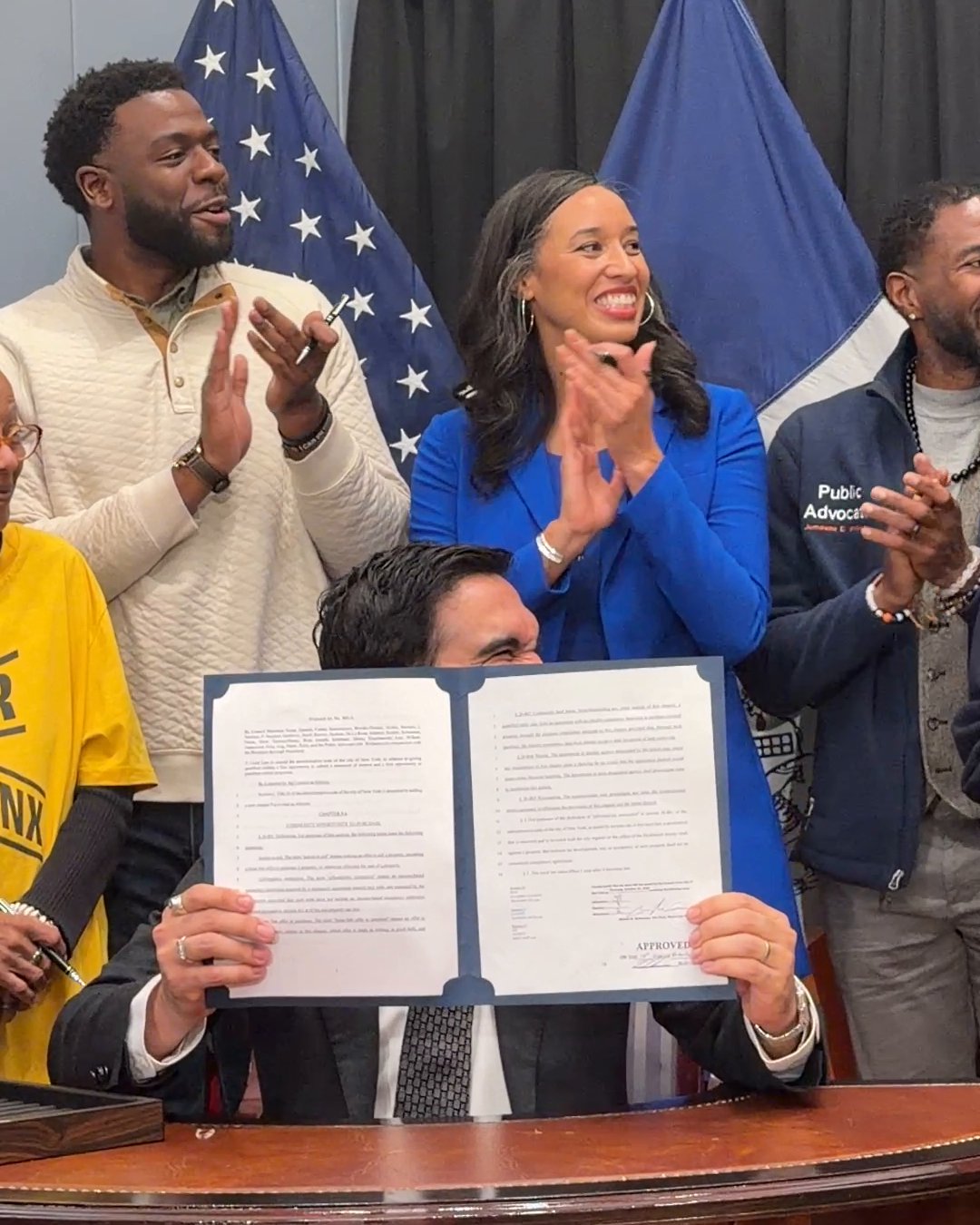
BROOKLYN, N.Y. — Mayor Zohran Mamdani signed the Community Opportunity to Purchase Act, known as COPA, into law Tuesday, Nov. 10, 2026, giving certified nonprofit housing groups the first chance to buy certain distressed or income-restricted apartment buildings in New York City when their owners decide to sell.
The mayor signed Intro 905-A shortly after 11:30 a.m. at the Cypress Hills East New York Community Center, 276 Chestnut St., surrounded by Council Member Sandy Nurse, the bill’s prime sponsor, Public Advocate Jumaane Williams, tenant organizers and housing groups. City Council records list the bill as enacted on Nov. 10 as Local Law 164 of 2026.
Under the law, owners of covered buildings must notify the city’s Department of Housing Preservation and Development (HPD) and certified nonprofits before selling. Those groups then get 20 days to say they are interested and 70 days to make an offer. The law takes effect one year after it became law, which puts the start date in November 2027.
“This law will give New Yorkers a tool to keep their homes out of the hands of predatory investors seeking to make a quick and easy buck,” Mamdani said before signing.
What COPA does: NYC nonprofits get the first offer on covered buildings
COPA creates a “right of first offer” for what the law calls qualified entities. These are nonprofits that HPD certifies, or joint ventures in which such a nonprofit holds a controlling interest. To be certified, a group must be a 501(c)(3) and show it has the money, legal capacity and experience to buy, repair and manage affordable housing, according to the text of Intro 905-A.
Community land trusts can take part by partnering with a qualified entity. A community land trust is a nonprofit that holds land for the long term so that the homes on it stay affordable.
Mamdani walked the crowd through the timeline before signing. If no qualified group steps forward, or if every offer is turned down, the owner can sell on the open market.
COPA timeline: 20 days, 70 days and a right of first refusal
The law sets these steps, according to the bill text:
- Notice. The owner of a covered building must tell HPD and every certified nonprofit that it intends to sell before taking any step to sell.
- 20 days to show interest. A qualified entity has 20 calendar days to send a statement of interest. The owner must then share the rent roll, a 12-month income and expense report, the mortgage balance, open violations and any open offers within 5 days.
- 70 days to make an offer. Interested groups get 70 more days to submit an offer. HPD can grant one 5-day extension. The owner cannot sell to anyone else during this window.
- 10 days to answer, 30 to sign. The owner has 10 days to accept, reject or counter. If the owner accepts or counters, the two sides have 30 days to sign a contract.
- Right of first refusal. If the owner rejects the nonprofit’s offer and then, within a year, gets an offer from another buyer it plans to accept, the first nonprofit bidder has 15 days to match that offer on the same terms.
The mayor’s office described the combined first-offer period as a 145-day window, followed by the one-year right of first refusal.
Owners who sell a covered building without the required notice face a civil penalty of up to 15 percent of the sale price. Nonprofits can also sue an owner within two years of a sale that broke the rules. Owners can apply to HPD for a waiver if following the law would cause “undue financial hardship.”

Which NYC buildings COPA covers, and which it exempts
COPA applies only to class A multiple dwellings, meaning residential apartment buildings, with four or more units. A building must also meet at least one of these tests when the owner moves to sell:
- It has been in HPD’s Alternative Enforcement Program, which targets buildings with serious repair problems, for at least one year.
- The city has found it to be a distressed property subject to an in rem tax foreclosure action.
- It has been under an HPD order to correct underlying conditions for at least one year.
- It averages three or more open hazardous or immediately hazardous violations per unit over the year.
- HPD denied it a certification of no harassment in the past year, with no cure.
- It has 100 or fewer units and is under an income-restricted regulatory agreement with HPD. Restrictions tied only to the 421-a tax break do not count.
Owner-occupied buildings with five or fewer units are exempt. The City Council said the law also exempts one- to three-family homes and transfers between family members, among other exclusions. Sales through inheritance, foreclosure, bankruptcy, eminent domain and co-op or condo conversions are also excluded under the bill text.
HPD must post the criteria on its website and send a written notice each year to owners whose buildings meet them. Owners can ask HPD for a hearing if they dispute that their building is covered.
What COPA means for NYC tenants and small homeowners
COPA does not give tenants a direct right to buy their building, and the law does not set rents or change leases. It controls who gets the first chance to buy a covered building when it goes up for sale. Tenants in a distressed building can work with a certified nonprofit or community land trust that wants to bid.
Williams spoke directly to homeowners worried about the bill. “This is not going to take your home. This is not going to take generational wealth. You will be able to pass your home down,” he said.
For tenants, the practical points are:
- Nothing changes until the law takes effect, one year after it became law, and HPD writes the rules for certifying nonprofits.
- HPD must post a public list of certified nonprofits, with contact information, on its website.
- Starting June 15, 2029, HPD must publish a yearly report on how many sale notices, offers and purchases happened under COPA.

COPA history: an Adams veto, then a 38–9 Council vote
A prior version of COPA passed the City Council and was vetoed by then-Mayor Eric Adams, according to the Council. The mayor’s office said the veto came in December 2025.
“Six years, four introductions, four hearings, three mayors,” Nurse said at the signing. “Two times it was passed, one time it was vetoed.”
The current bill was introduced May 14, 2026, and heard by the Committee on Housing and Buildings on Sept. 9. The committee amended and approved it on Oct. 22, and the full Council passed it the same day, according to Council records. The vote was 38 to 9 with two abstentions, amNY reported. The mayor held a public hearing on the bill on Nov. 4.
The final version shortened the deadlines. The bill Adams vetoed gave nonprofits 25 and 80 days, according to amNY.
The bill lists 33 Council sponsors plus the Public Advocate, and was introduced in conjunction with the Brooklyn Borough President. Nurse represents Council District 37 in Brooklyn.

Voices from the COPA signing in Cypress Hills
Mamdani tied the bill to his housing plan. “In May, when we announced our landmark housing plan, Block by Block, we made a promise to New Yorkers,” he said, adding that the city would preserve 200,000 affordable homes over the next decade.
“Across the five boroughs of our city, countless buildings have been allowed to become the opposites of monuments to love. They have become monuments to profit,” the mayor said.
“I especially want to thank Council Member Sandy Nurse,” Mamdani said, crediting her with shepherding the bill.
Nurse said that once signed, COPA “will be the largest opportunity to purchase program in the country.” NYC In Focus has not independently confirmed that comparison. She called COPA “the anti-displacement tool” the city needs to move at-risk buildings into the hands of trusted housing organizations that can make repairs and keep tenants in place.
Williams, who said he was an organizer 25 years ago, credited the advocates who “kept fighting to get COPA over the finish line.” He also referred to the earlier veto: “No thanks to the last mayor’s veto, on the way out the door.”

The event was held at a community center run by Cypress Hills Local Development Corporation, which the mayor thanked for hosting. Supporters held signs reading “Invest in Stable Homes,” and the room chanted “COPA!” before Williams spoke.
What’s next for COPA: HPD rules and a certified nonprofit list
HPD now has to write rules that set how nonprofits get certified, build an electronic system for sale notices, and publish the list of covered-building criteria. The law takes effect one year after it became law.
HPD Commissioner Dina Levy said in a statement released by the mayor’s office that the agency looks forward “to implementing COPA and helping keep more New Yorkers in safe, stable housing.”
What the official record does not say
The city has not published a final count of buildings that would be covered. Published estimates have varied, and the number will depend on which buildings meet the tests when an owner moves to sell. The law itself does not include funding for nonprofit purchases. Which groups HPD will certify, and when, is not yet known.

Sources
- NYC Council Legistar: Int. 0905-2026 (Local Law 164 of 2026)
- Full text of Int. No. 905-A
- NYC Council press release, Oct. 22, 2026
- Council Member Sandy Nurse, Oct. 22, 2026
- amNY, Oct. 22, 2026
- Remarks recorded by NYC In Focus at the signing, Nov. 10, 2026
More city housing coverage: Housing · Civic Watch · Editorial standards
Photos and video by Howard Weiss for NYC In Focus. Footage available for licensing: contact NYC In Focus.